
Many iconic U.S. landmarks were originally designed to be much more ambitious, but practical constraints like cost and engineering limitations forced creators to scale back their visions. A new project explores what these structures might have looked like if their original designs had been fully realized by creating visual interpretations of those initial concepts. The project also examines how modern construction methods and technology could potentially overcome the historic challenges that made those early, elaborate designs impractical to build at the time.
- Golden Gate Bridge
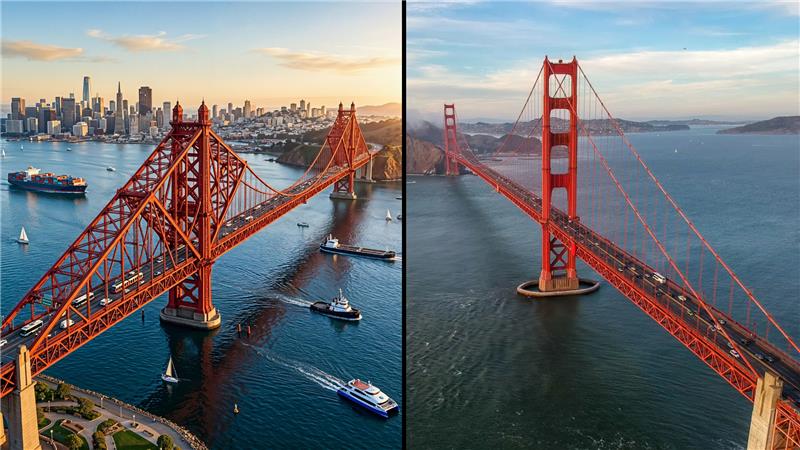
The Golden Gate Bridge was not always envisioned as the sleek suspension bridge seen today. Engineer Joseph Strauss initially proposed a hybrid suspension–cantilever bridge with large truss structures supporting the roadway, a design focused more on practicality than aesthetics. As planning progressed, collaboration with engineers such as Leon Moisseiff and Charles Alton Ellis, along with architect Irving Morrow, led to a shift toward a pure suspension design that was both structurally efficient and visually striking. Completed in 1937, the final bridge replaced the heavy truss concept with graceful cables and two tall towers, creating the streamlined silhouette that has become one of the most recognizable landmarks in the world.
How Modern Construction Techniques Could Enable the Original Concept
Modern construction technologies could easily support Strauss’s original hybrid idea if it were built today. Advanced computer modeling and wind tunnel testing would allow engineers to optimize a cantilever-suspension combination for stability and efficiency. High-strength steel, improved cable materials, and modern seismic design methods could reduce the structural bulk that made early proposals appear heavy. While the hybrid concept may not have matched the elegance of the final design, contemporary engineering tools could make such a structure both practical and visually refined.
2. Mount Rushmore
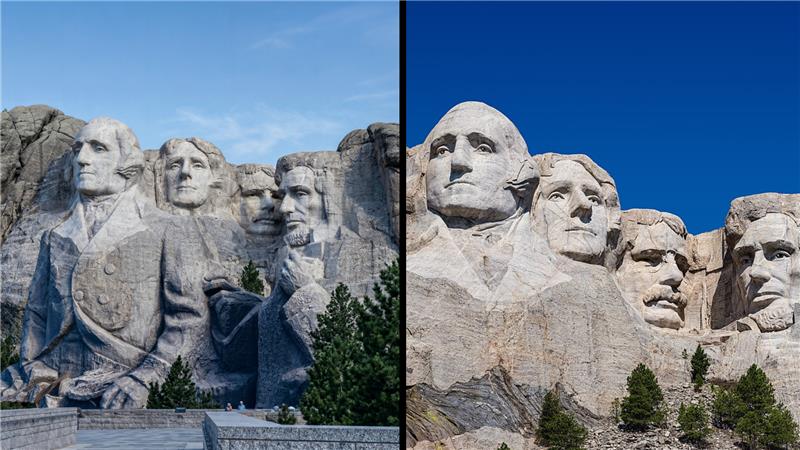
Mount Rushmore was originally envisioned by sculptor Gutzon Borglum as a far more ambitious monument than the four presidential faces visible today. Borglum planned to carve full-body or waist-up sculptures of George Washington, Thomas Jefferson, Theodore Roosevelt, and Abraham Lincoln, along with a monumental Hall of Records that would house important documents from American history. However, funding limitations during the Great Depression, technical challenges of carving the granite mountain, and time constraints forced the project to be scaled back. When the monument was completed in 1941, the design focused solely on the 60-foot-tall presidential heads, leaving Borglum’s larger vision only partially realized.
How Modern Construction Techniques Could Enable the Original Concept
With today’s technology, Borglum’s original vision might have been far more achievable. Precision drilling, controlled blasting, and 3D laser scanning could allow sculptors to map and carve granite with far greater accuracy and safety. Heavy-lift equipment, drones, and digital modeling could also help plan and execute complex carvings across difficult terrain. These tools might make it possible to safely create the larger full-figure sculptures Borglum originally imagined.
3. Statue of Liberty
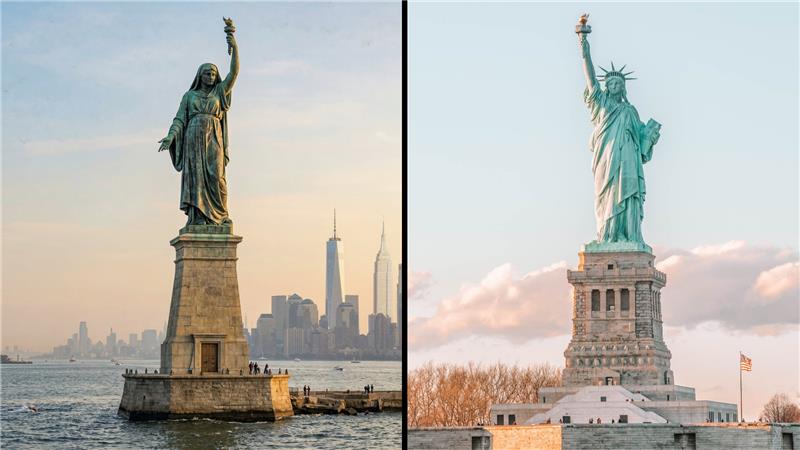
The Statue of Liberty began as a very different concept before becoming the symbol of freedom recognized today. French sculptor Frédéric Auguste Bartholdi initially designed a monumental figure called “Egypt Carrying the Light to Asia,” intended to stand at the entrance of the Suez Canal as a symbol of progress. When that proposal proved too costly for Egypt, Bartholdi reworked the idea for the United States as “Liberty Enlightening the World,” transforming the statue’s symbolism while retaining the iconic torch-bearing form. Dedicated in 1886 in New York Harbor, the finished monument stands as one of the most recognizable statues in the world.
How Modern Construction Techniques Could Enable the Original Concept
Modern construction techniques could easily support the monumental canal-side statue Bartholdi originally envisioned. Contemporary composite materials, prefabricated structural frameworks, and advanced corrosion-resistant metals would simplify the engineering challenges of building large statues in coastal environments. With digital design tools and large-scale fabrication technology, engineers could produce massive sculptural forms with greater efficiency and durability.
4. S. Capitol Building
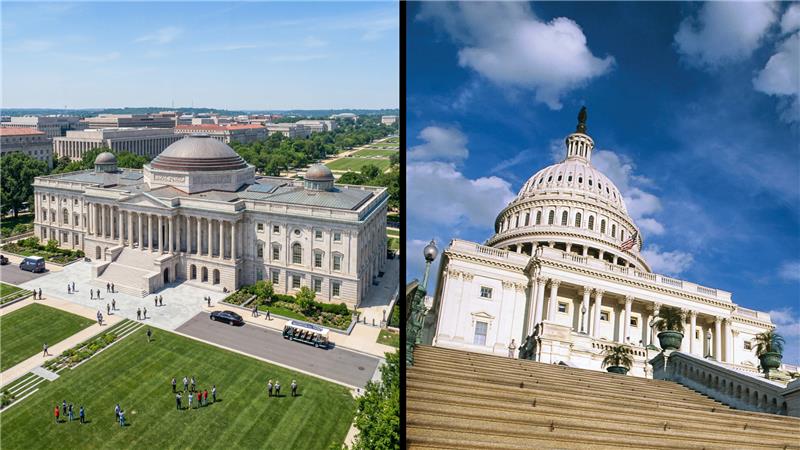
The U.S. Capitol Building originally featured a much smaller dome than the one that defines its skyline today. Architect William Thornton designed the Capitol with a modest copper dome, which suited the scale of the early federal government. However, when large House and Senate wings were added in the 1850s to accommodate a growing Congress, the original dome appeared too small for the expanded building. Architect Thomas U. Walter replaced it with a much larger cast-iron dome, completed during the Civil War, creating the towering structure crowned by the Statue of Freedom that now dominates the Capitol’s silhouette.
How Modern Construction Techniques Could Enable the Original Concept
If the Capitol were designed today, modern structural engineering could make the original dome concept far more adaptable. Lightweight steel framing, advanced alloys, and structural modeling software could allow architects to scale a copper-style dome while maintaining proportional harmony with expanding wings. Modern prefabrication techniques would also simplify installation and long-term maintenance of large architectural domes.
5. Washington Monument
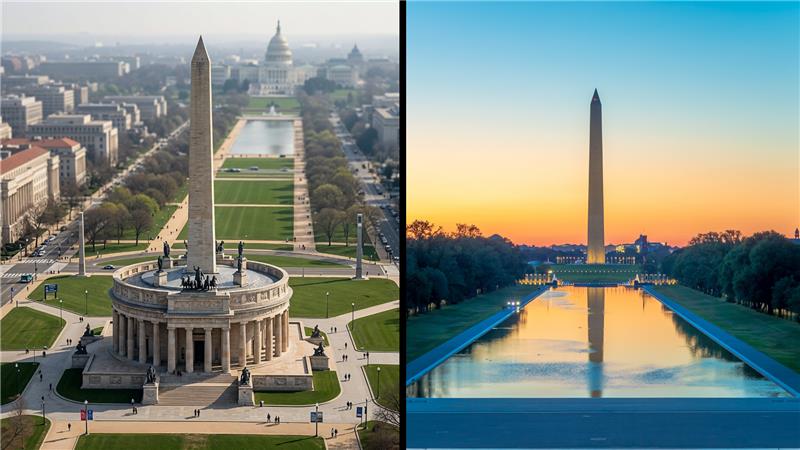
The Washington Monument was originally planned as a far more elaborate structure than the stark obelisk seen today. Architect Robert Mills proposed a towering obelisk surrounded by a grand circular colonnade decorated with statues of notable Americans, and some early concepts even included an equestrian statue of George Washington near the base. Financial difficulties, political disagreements, and the Civil War halted construction for decades, and when work resumed in the 1870s the project was simplified to ensure completion. Finished in 1884, the monument stands as a 555-foot marble obelisk with minimal ornamentation, dramatically different from Mills’s original decorative vision.
How Modern Construction Techniques Could Enable the Original Concept
Today’s construction methods could make Mills’s elaborate design far easier to execute. Advanced stone fabrication, large-scale prefabrication, and modern crane technology would simplify the installation of colonnades and sculptural elements. Computer-aided design and structural simulations could also ensure that decorative additions integrate safely with the towering obelisk, potentially allowing the monument to incorporate the grand architectural base Mills originally imagined.
What These Design Changes Tell Us About Construction Innovation
The evolution of these landmarks shows that even the most iconic structures are often the result of compromise. Budget constraints, technical challenges, and changing priorities shaped the final versions of monuments like the Golden Gate Bridge, Mount Rushmore, and the Washington Monument.
While those decisions ultimately created the landmarks we recognize today, they also highlight how far construction technology has advanced. Modern engineering tools, materials, and equipment allow builders to plan more precisely, manage costs more effectively, and execute ambitious designs that might once have been considered impractical. In many ways, today’s construction innovations are helping architects and engineers realize the kinds of bold ideas that earlier generations could only imagine.
Bring Ambitious Designs to Life with the Right Equipment
Ambitious construction projects have always required a balance between vision, practicality, and the tools available at the time. While modern engineering and construction technologies make it easier to tackle complex designs today, the success of any project still depends on having reliable equipment and components that can perform in demanding environments.
At Astrak, we support construction professionals around the world with durable undercarriage solutions built for tough jobs. If you’re looking for dependable performance on site, explore Astrak’s range of high-quality rubber tracks designed to keep machinery moving efficiently in challenging conditions.

About Astrak US
Astrak is a leading global supplier of undercarriage and wear parts for heavy machinery, serving industries such as construction, demolition, forestry, agriculture, mining, defense, and OEM. Established in 2003, Astrak has built a reputation for delivering high-quality, reliable components — including rubber tracks, rubber pads, buckets, rollers, idlers, sprockets, and hydraulic parts — all designed to maximize machine uptime and performance.
Astrak entered the United States market in 2023 and has quickly established a strong foundation with warehouses in Texas to provide fast delivery and dedicated service nationwide. With the US operation in rapid growth mode, Astrak is expanding its reach, resources, and customer support capabilities to meet the increasing demand for reliable undercarriage and wear parts for heavy machinery. Offering a comprehensive inventory covering over 4,000 machine models, all products are manufactured in ISO 9001-certified facilities, with many backed by an industry-leading 24-month warranty. Combined with a robust logistics network and customer-first approach, Astrak US is a trusted partner for businesses seeking dependable, cost-effective solutions for their heavy equipment needs.