
- Poland is installing an additional four-meter-high mesh fence and thermal-imaging cameras along the border with Belarus to bolster security against hybrid threats.
- The country announced the reopening of two border crossings (Bobrowniki–Bierestowica and Kuźnica Białostocka–Bruzgi) that were closed in response to Russian and Belarusian military exercises.
- The Bobrowniki crossing will be restricted to freight vehicles registered in EU/EFTA countries, while the Kuźnica crossing will be limited to passenger traffic only.
- Prime Minister Donald Tusk stated the borders were reopened after being sealed sufficiently to reduce the risk of illegal crossings to a minimum.
Poland has announced that it is implementing additional security measures along its border with Belarus, primarily to counter perceived hybrid threats and deter illegal crossings. This move involves erecting an additional four-meter-high mesh fence in the Podlaskie province, which will run parallel to the existing metal barrier and be reinforced with barbed wire. The new fence will also be equipped with thermal-imaging cameras mounted on ten-meter poles.
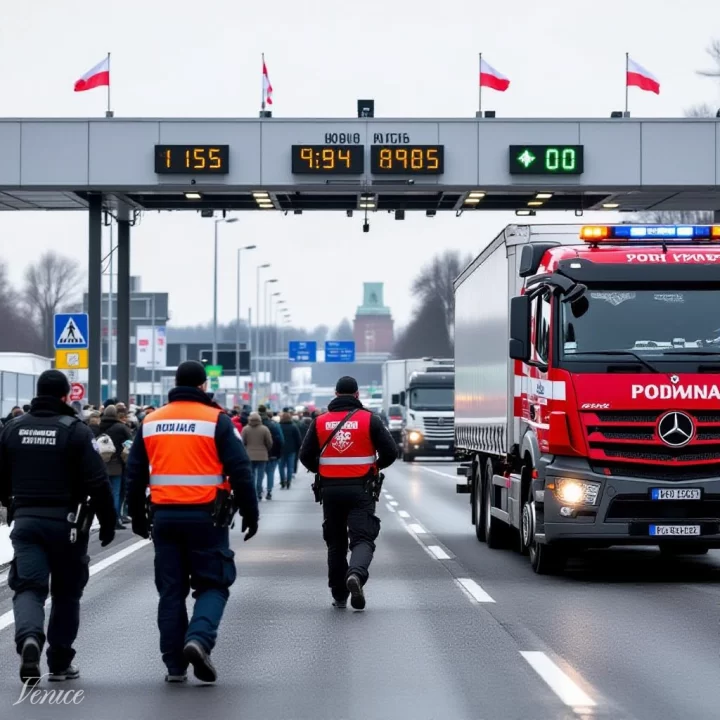
The decision to bolster security coincides with Poland’s announcement that it will reopen two border crossings with Belarus that had been closed since September following large-scale military exercises by Belarusian and Russian forces. Prime Minister Donald Tusk confirmed the reopening, stating that the border has been sufficiently sealed to minimize the risk of illegal crossings, allowing for a resumption of traffic flow.
The first crossing to reopen will be Bobrowniki–Bierestowica, which will operate with freight traffic restrictions, limited to vehicles registered in EU, EFTA, and Swiss Confederation member states. The second crossing, Kuźnica Białostocka–Bruzgi, will reopen with restrictions for passenger traffic, excluding bus traffic. Tusk expressed hope that politics would not interfere with the crossings, which are intended to serve ordinary people. Poland has long accused Belarus of using asylum seekers to destabilize the country by encouraging mass border crossings.