
- Industrial Specialization: Europe adapted post-war shipyards for leisure vessels, while the U.S. focused on defense and cargo.
- Complexity of Construction: Cruise ships require specialized supply chains for hospitality and safety that exist primarily in Europe.
- Regulatory Constraints: U.S. laws like the Jones Act make domestic shipbuilding and operation commercially unattractive for cruise lines.
- Cumulative Expertise: European yards benefit from decades of continuous experience and knowledge transfer in passenger ship design.
The cruise industry presents a unique paradox where the United States dominates as the primary market and home to major cruise lines, yet virtually all large cruise ships are constructed in Europe. This disconnect stems from divergent post-World War II industrial strategies. While the U.S. excelled in mass-producing standardized cargo and naval vessels during the war, it subsequently demobilized its commercial shipbuilding sector to focus on high-tech defense contracts. In contrast, European shipyards, facing the decline of transatlantic liners, adapted their existing infrastructure and skilled labor force to meet the evolving needs of the leisure cruise market.
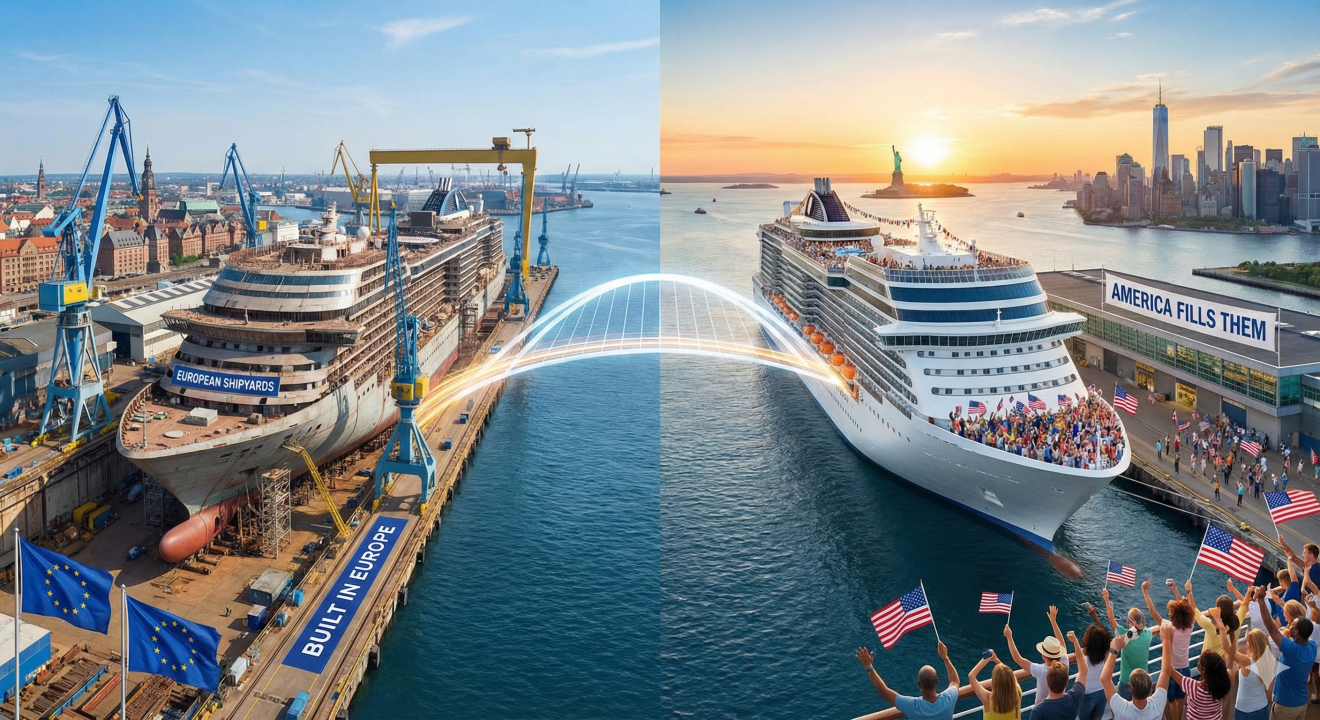
Cruise ships are complex floating hospitality platforms requiring intricate integration of marine engineering with hotel operations, entertainment, and safety systems. European yards like Fincantieri, Chantiers de l’Atlantique, and Meyer Werft cultivated specialized ecosystems of subcontractors and a workforce expert in passenger ship outfitting. This created a cumulative “muscle memory” that allowed for the efficient construction of increasingly sophisticated vessels. The U.S., having shifted its maritime focus, lacked the continuous institutional knowledge and specialized supply chains necessary for such high-complexity commercial projects.
Furthermore, U.S. maritime laws, specifically the Passenger Vessel Services Act and the Jones Act, discourage domestic construction by imposing strict operational and crewing requirements that increase costs and limit flexibility. Cruise lines avoid these constraints by building in Europe and registering ships under foreign flags. Consequently, the industry operates with American demand driving the market, while European expertise supplies the hardware, creating a global operational model rooted in historical industrial specialization.