
- Long-Term Renewable Fuel Supply NCLH and Repsol have secured an 8-year agreement for renewable marine fuels at the Port of Barcelona, starting in 2026.
- Fuel Types and Origin Repsol will supply biofuels and, from 2029, renewable methanol, with the latter produced from urban waste at Repsol’s Ecoplanta facility in Spain.
- Sustainability and Decarbonization Goals The partnership aligns with both companies’ Net Zero by 2050 targets and NCLH’s Sail & Sustain program for reducing greenhouse gas emissions.
- Cross-Industry Collaboration and Standards This agreement is a significant example of cross-industry collaboration, with fuels certified under the ISCC EU framework, supporting regulatory compliance.
Norwegian Cruise Line Holdings Ltd. (NCLH) and Repsol have announced an 8-year agreement for the supply of renewable marine fuels at the Port of Barcelona. This collaboration, commencing in the 2026 European season, aims to position both companies at the forefront of the energy transition within the cruise and maritime sectors.
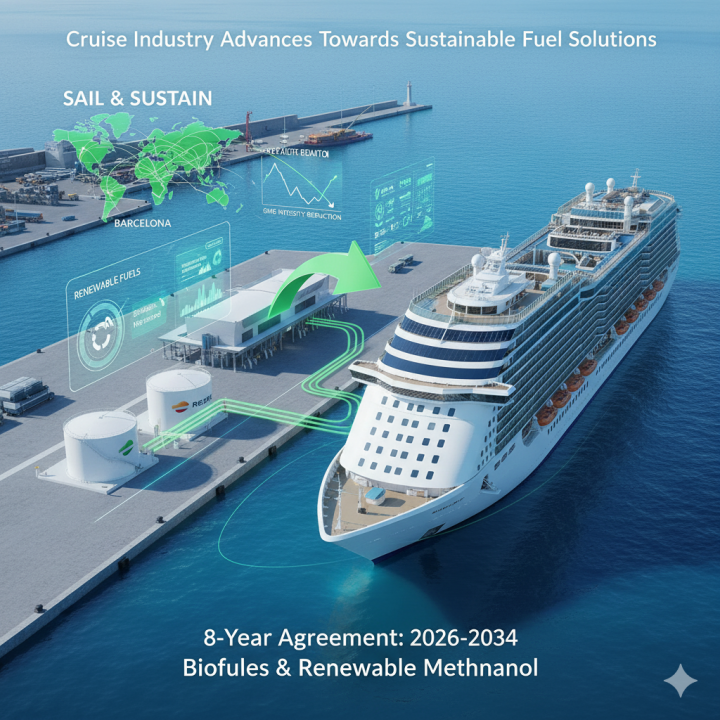
Under the agreement, Repsol will provide a portfolio of renewable fuels to NCLH vessels, including biofuels and, from 2029, renewable methanol. This supply will benefit NCLH’s cruise brands—Norwegian Cruise Line, Oceania Cruises, and Regent Seven Seas Cruises—during their calls at the Port of Barcelona. This initiative is a component of NCLH’s Sail & Sustain program and supports its commitment to a more sustainable future in line with both companies’ pursuit of Net Zero by 2050.
All fuels provided will be certified under the ISCC EU framework, meeting the necessary environmental compliance standards. The renewable methanol will be produced at Repsol’s Ecoplanta facility in Tarragona, Spain. This pioneering project, set to begin operations in 2029, will convert urban waste into renewable fuels and circular products, with NCLH being the first company to sign an offtake agreement for its renewable methanol. This plant aims to process up to 400,000 tons of municipal solid waste annually into 240,000 tons of renewable fuels.
This alliance highlights NCLH’s strategy to advance low-carbon fuel solutions while maintaining operational flexibility and cost efficiency. It directly supports the company’s global program, Sail & Sustain, which focuses on reducing greenhouse gas intensity and investing in innovative fuel solutions. Repsol’s broader strategy also involves supplying renewable fuels across various transport sectors, with existing and planned production facilities for renewable diesel and sustainable aviation fuel (SAF). The company is expanding its renewable fuel distribution network in Europe.