
- Impact of severe wind gusts on mooring security
- Technical distinction between collision and allision events
- Minor nature of the damage sustained by both vessels
- Clearance for ships to continue Antarctic expeditions
On January 8, 2026, a maritime incident occurred at the port of Ushuaia, Argentina, involving two expedition cruise vessels, the World Voyager and the Viking Octantis. The event was precipitated by severe weather conditions, specifically a sudden wind gust reaching 40 knots. At the time, sustained winds were recorded at approximately 30 knots, hovering just below the threshold at which port authorities typically suspend operations. These forceful conditions caused the World Voyager, operated by Atlas Ocean Voyages, to break free from its moorings. As the vessel drifted, its port bow made unintended contact with the stern of the adjacent Viking Octantis.
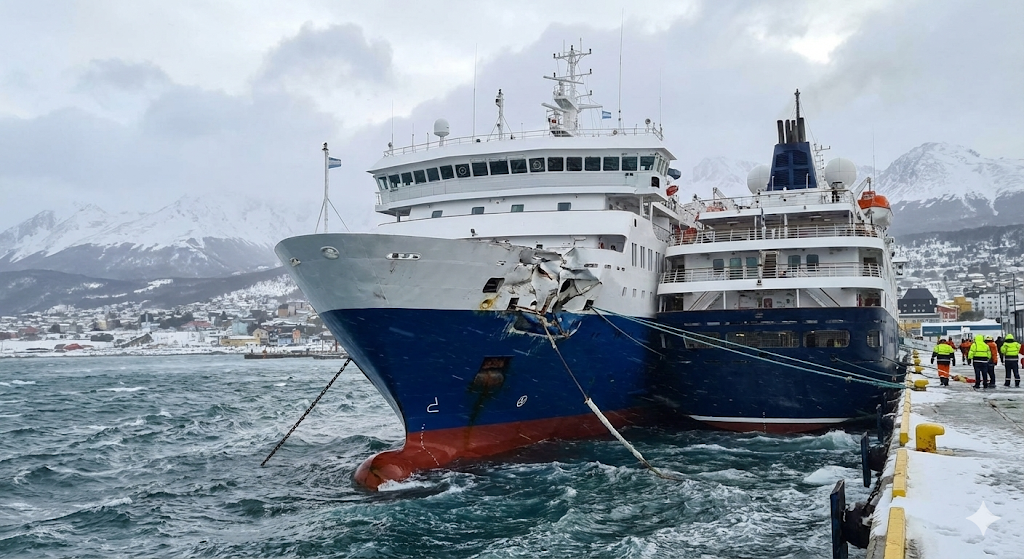
Although initially described by some observers as a collision, the incident is technically classified as an allision, which refers to a moving ship striking a stationary object or vessel. Video footage of the event highlights the crew of the World Voyager executing emergency maneuvers to minimize the impact. Subsequent damage assessments revealed that the Viking Octantis sustained minor damage to an external deck, while the World Voyager suffered a crack in its bow plating.
Despite the dramatic nature of the event, technical inspections confirmed that neither ship sustained structural or safety-critical damage. Consequently, port authorities cleared both vessels to proceed with their scheduled operations. The Viking Octantis continued its 11-night expedition, which includes a crossing of the Drake Passage and exploration of the Antarctic Peninsula. Similarly, the World Voyager departed for its ten-night Antarctic Discovery Cruise, featuring stops in the South Shetland Islands. Both ships are modern vessels specifically designed for polar operations, allowing them to withstand the rigorous conditions of high-latitude travel.