
- Widespread airspace closures over the Middle East have disabled primary flight corridors for international travel.
- Over 440 flights were disrupted at Heathrow, Gatwick, and Manchester, leaving thousands of passengers stranded.
- Carriers such as Emirates and British Airways have suspended major routes to the Gulf and Israel due to security concerns.
- The UK Foreign Office has issued a shelter-in-place advisory for citizens currently located in high-risk regional zones
The United Kingdom’s aviation sector is currently experiencing a period of intense operational instability following significant geopolitical escalations in the Middle East. On March 2, 2026, the cumulative impact resulted in 319 flight delays and 126 cancellations across the country’s three primary air hubs: Heathrow, Gatwick, and Manchester. This logistical crisis was triggered by military strikes involving the United States, Israel, and Iran, which led to the immediate closure of critical airspace over multiple nations including Iraq, Syria, and parts of the United Arab Emirates. As these transit corridors are vital for long-haul travel, global carriers have been forced to either suspend services entirely or implement complex rerouting strategies.
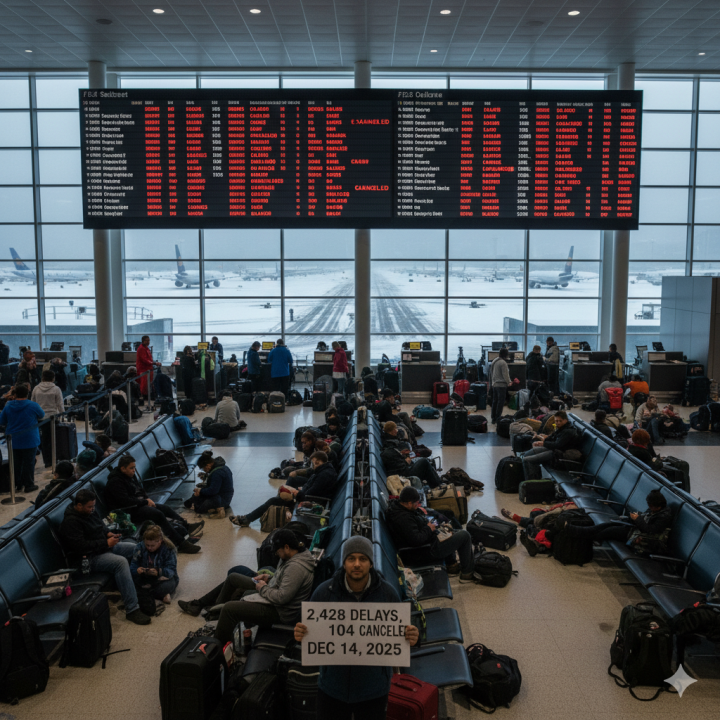
London Heathrow has emerged as the most severely affected airport, managing a total of 84 cancellations and 110 delays. Major international carriers such as British Airways, Emirates, and Qatar Airways have scrapped numerous services to high-traffic destinations like Dubai, Doha, and Abu Dhabi. However, the disruption is not localized to Middle Eastern routes; transatlantic and European flights to cities such as Los Angeles, Paris, and Barcelona are also facing delays. These setbacks occur as airlines are forced to navigate around conflict zones, adding significant time and fuel requirements to standard flight paths.
The operational strain on airlines is considerable. Emirates has halted flights in and out of Dubai, noting that returning to a regular schedule could take several days. Similarly, Virgin Atlantic and Qatar Airways have alerted passengers that flights to India and the Maldives will see increased durations due to mandatory circumnavigation of restricted zones. In terms of specific regional suspensions, British Airways has paused all flights to Tel Aviv and Bahrain until at least the middle of the week.
In light of these safety risks, the UK Foreign Office has moved to a high state of alert, advising British citizens against all but essential travel to several Gulf nations. For those currently in the affected regions, the official recommendation is to shelter in place. While there are discussions regarding potential government-led evacuation measures, the current closure of various regional airports makes such logistical planning difficult to finalize. Passengers are strongly encouraged to maintain active communication with their airlines and monitor flight statuses in real time, as the timeline for regional stabilization and the reopening of airspace remains highly uncertain.